

"When a viral health post is wrong, I say so. This time it is mostly right — and that is exactly why the missing context matters. A real, promising result becomes dangerous the moment someone uses it to treat the wrong cancer, in the wrong way, alone."
— Dr Eugene Pretorius, Cancer SA Centurion
From Dr Eugene Pretorius
A post has been going viral claiming that a simple topical mix — vitamin C dissolved in DMSO — completely eliminated 56% of biopsy-confirmed skin cancers in just 12 weeks, and let 94% of patients avoid surgery.
Usually when I investigate these claims, I find the science has been twisted. Not this time. The studies behind this post are real, they are published, and the results are genuinely encouraging.
But "mostly true" is not the same as "the whole story" — and with cancer, the missing parts are the ones that keep you safe. So let me give you the honest, complete picture: what the research actually found, which skin cancers it applies to (and which it absolutely does not), why it works, and the safety facts the viral post skips over.
The Viral Claim
The post — shared widely from an anonymous account — states:
"A new study found vitamin C in DMSO eliminated 56% of diagnosed skin cancers in just 12 weeks — 94% of patients avoided surgery. A 2022 trial found even higher..."
Those numbers are accurate. What the post doesn't make clear is that they come from two small studies, of two specific kinds of superficial skin cancer — and that one of them hasn't been peer-reviewed yet. Both of those details matter enormously.
The Actual Studies
The 2022 trial — basal cell carcinoma (peer-reviewed, randomised)
This is the stronger of the two. Published in the respected journal Biomedicine & Pharmacotherapy, it was a randomised controlled trial — the kind of study that can actually compare treatments fairly.1
- 25 patients, 29 biopsy-confirmed basal cell carcinomas (BCC)
- Treatment: 30% ascorbic acid (vitamin C) in 95% DMSO, applied twice daily for 8 weeks
- Compared head-to-head against imiquimod — a standard, established prescription skin-cancer cream
The vitamin C solution completely cleared 13 of 15 lesions (86.7%). Imiquimod cleared 8 of 14 (57.1%). The difference was statistically significant.
In other words, a cheap topical vitamin C solution outperformed a standard prescription treatment for basal cell carcinoma in this trial. That is a striking, legitimate finding.
The 2025 study — squamous cell carcinoma in situ (the "56%")
This is the source of the viral "56%" figure. It was published as a preprint on medRxiv in October 2025 — meaning it is early, and has not yet been through peer review.2
- 17 patients, 27 biopsy-confirmed lesions of squamous cell carcinoma in situ (SCCIS)
- Same formulation: 30% ascorbic acid in 95% DMSO, brushed on twice daily for 12 weeks
- 56% of lesions completely cleared (confirmed by re-biopsy under the microscope)
- Average lesion area shrank by 71%; a further group shrank by more than 85%
- 94% of patients avoided surgery; only 2 of 27 lesions failed to respond at all
- It was well tolerated — no one stopped because of side effects
Encouraging — but note that "56% cleared completely" also means 44% did not fully clear and needed further monitoring or treatment. The headline tells the good half of the story.
Both studies come from the same research group (Center for Biomedical Research, Boise), and there is an ongoing registered clinical trial continuing this work.3
Which Skin Cancers This Applies To — and Which It Does NOT
This is the single most important section on this page, so I am going to be blunt.
Everything above applies only to superficial, non-melanoma skin cancers that sit in the outer layers of the skin:
- Basal cell carcinoma (BCC) — the most common and least aggressive skin cancer
- Squamous cell carcinoma in situ (SCCIS / Bowen's disease) — an early squamous cancer still confined to the top layer of skin
These are exactly the cancers a topical treatment can physically reach. And that is the point of the DMSO — to carry the vitamin C down to them.
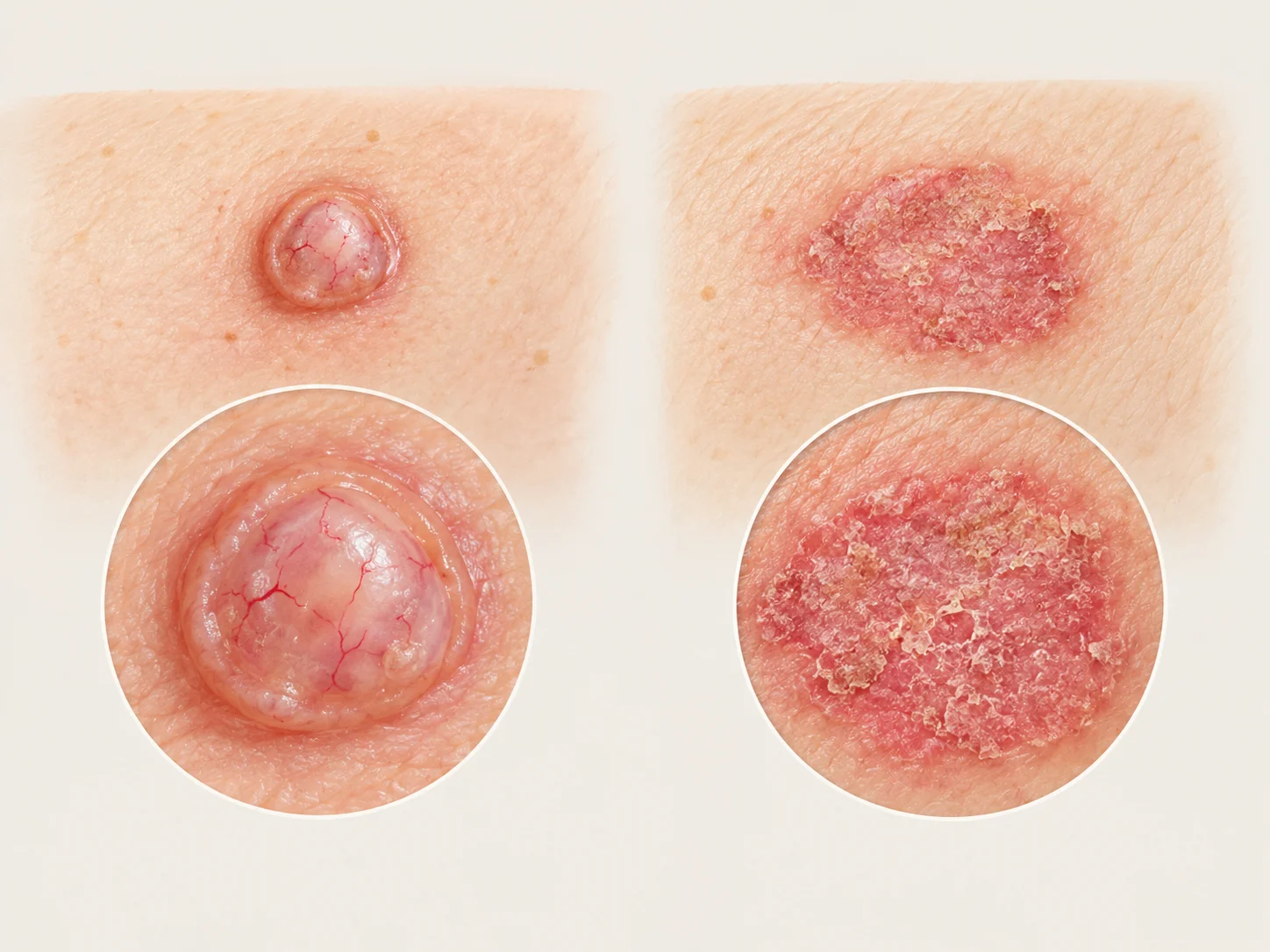
This has NOT been shown to work — and must NOT be used — for: melanoma, invasive or nodular squamous cell carcinoma, or any cancer that has grown deeper than the skin surface. Melanoma in particular can be deadly, spreads early, and requires proper medical treatment. A topical cream cannot reach or control it. Trying to treat a melanoma this way could cost you your life.
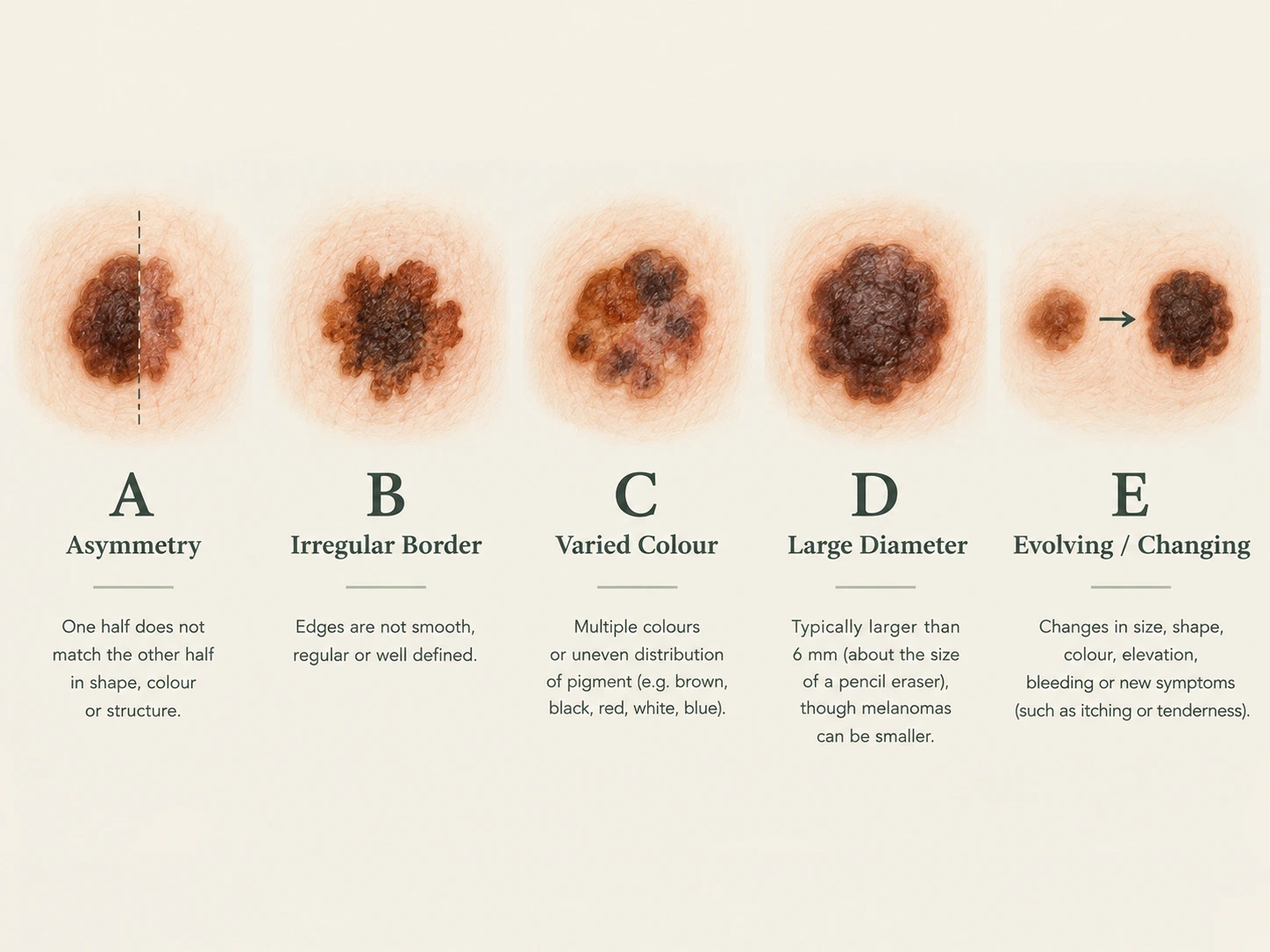
The one thing to watch for is melanoma, which can masquerade as an innocent-looking spot. You don't need to biopsy every small, superficial-looking lesion — but you do need to know the melanoma warning signs, the ABCDEs: Asymmetry, irregular Borders, more than one Colour, Diameter over about 6 mm, or a spot that is Evolving — changing, bleeding, or not healing. Any of those, and it should be assessed properly before anything else. That is the one situation where waiting is genuinely dangerous.
Why It Works — the Chemistry
This is where it connects to something we understand deeply at Cancer SA. Vitamin C has a remarkable double life:
- At low, everyday doses, it's an antioxidant — it protects your cells.
- At very high concentrations, it flips and becomes a pro-oxidant — it generates hydrogen peroxide right inside the tissue.4
Here's why that selectively harms cancer: healthy cells are well-equipped with enzymes (like catalase) to mop up hydrogen peroxide. Cancer cells are not — and they tend to carry more reactive iron, which reacts with that peroxide to form destructive free radicals (Fenton chemistry). The result is oxidative damage to the cancer cell's DNA, proteins and membranes — while normal cells nearby largely shrug it off.56
Where does the DMSO come in? Vitamin C alone can't get through the skin's tough outer barrier in high enough amounts. DMSO (dimethyl sulfoxide) is a powerful penetration carrier — it ferries the concentrated vitamin C down into the lesion where the chemistry can do its work. The DMSO isn't the cancer-killer; it's the delivery vehicle.
The right form of vitamin C — and why it matters
In plain terms — what to ask for at the pharmacy:
- "Pure L-ascorbic acid powder, pharmaceutical (USP) grade." Say plain ascorbic acid — not a vitamin C serum, and not sodium/calcium/magnesium ascorbate or ascorbyl palmitate/phosphate.
- "Pharmaceutical (USP) grade DMSO, 99.9%+." Not the industrial/hardware type.
- Ask a compounding pharmacist to mix it fresh as 30% ascorbic acid in DMSO, and get a new batch about every 2 weeks.
- Keep it in the fridge, out of the light. If it turns brown, throw it away — it has gone off.
This is where many people go wrong: not any "vitamin C" will do. The studies used pure L-ascorbic acid — the plain, active form of vitamin C — at 30% concentration, in pharmaceutical (USP) grade. That specific form is the one that readily generates the hydrogen peroxide that does the work.
These common alternatives do not do the same job:
- Skincare "vitamin C serums" — usually only 10–20% strength, blended with many other ingredients (which DMSO would carry into your skin too), and often built around gentler derivatives. They're designed to be surface antioxidants — the opposite of the pro-oxidant effect needed here.
- Buffered ascorbate salts (sodium ascorbate, calcium or magnesium ascorbate) — chemically stable, but they lack the pro-oxidant punch of plain ascorbic acid.
- "Stable" ester derivatives (ascorbyl palmitate, sodium or magnesium ascorbyl phosphate, ascorbyl glucoside) — the "won't-oxidise" forms sold in cosmetics. Their entire selling point is that they don't do the reactive chemistry — which is exactly the chemistry you want here.
Freshness is non-negotiable. Pure L-ascorbic acid oxidises quickly once mixed into solution — you can watch a fresh, clear solution turn yellow and then brown as it degrades into breakdown products that do nothing useful. In the studies, patients were given a freshly made batch every two weeks and kept it cool and out of the light. If the solution has turned brown, it is spent — discard it, don't use it. This is another reason to have it prepared properly rather than improvised.
If this mechanism sounds familiar, it should: it is the same pro-oxidant chemistry behind high-dose IV Vitamin C, which delivers vitamin C to the whole body at blood levels that are impossible to reach by swallowing tablets. Topical-in-DMSO and intravenous are two different ways of using one well-documented biological principle.
An Honest Word on the Limits
I would be doing you a disservice if I only told you the exciting half. So, plainly:
- The studies are small. 25 and 17 patients. Encouraging signals — not the large, definitive trials that change standard practice.
- They come from a single research group. Promising early work becomes solid science when other teams reproduce it. That independent replication hasn't happened at scale yet.
- The 56% study is a preprint — it has not yet passed peer review, so treat its numbers as preliminary.
- The SCCIS study had no control group (it was open-label), which makes results easier to over-read than in the randomised BCC trial.
- It is superficial, non-melanoma cancer only — as covered above, and worth repeating.
None of this means the finding isn't real or important. It means it is early, genuine, and worth watching closely — exactly the kind of low-cost, mechanism-driven approach that integrative oncology has always taken seriously, done properly rather than hyped.
The DMSO Safety Facts the Viral Post Skips
DMSO is not a harmless kitchen ingredient, and its single most useful property is also its most dangerous one: it carries whatever it touches straight into your body.
- Grade matters enormously. Only pharmaceutical / USP-grade DMSO (99.9%+ pure) is fit for use on the body. Industrial-grade DMSO — sold as a solvent or degreaser — can contain heavy metals, benzene and acetone, which DMSO will then carry directly into your bloodstream.7
- Contamination on the skin gets carried in too. Anything on your hands or the lesion — dirt, other creams, chemicals — can be dragged inward. The skin must be clean and nothing else applied.
- DMSO is FDA-approved only for one condition (a bladder condition, interstitial cystitis) — not for cancer. Its role in these studies is as a research delivery agent, not an approved treatment.
- Common effects include a garlic-like taste and odour, and skin irritation at the site.
This is precisely why the "just buy some DMSO and vitamin C online" version of this story worries me. The studies used controlled concentrations and pharmaceutical-grade materials, under supervision. A DIY version with the wrong grade, on an undiagnosed lesion, is a genuinely risky combination.
A Non-Invasive First Step — Without the Unnecessary Cut
Here is where I part ways with the reflexive "biopsy everything first" approach. A biopsy is itself a small surgical procedure — a cut, a wound, often a scar. For most patients, the whole appeal of an approach like this is avoiding the knife. It makes little sense to insist on cutting into a lesion just to decide whether to use a treatment designed to spare you exactly that.
So for a small, clearly superficial-looking suspected skin cancer, a supervised trial of treatment first is a sensible, patient-friendly path:
- Treat first, and watch the response. Superficial basal cell and Bowen's-type lesions tend to respond within the treatment window. A lesion that clears has spared you both a biopsy and surgery.
- Biopsy only if it does not respond. If a lesion fails to improve over the treatment period, that is the signal to investigate further. You have lost nothing — and you have avoided an unnecessary procedure on all the lesions that would have cleared anyway.
- The one firm exception is melanoma. If a spot shows the melanoma warning signs (the ABCDEs above), don't treat-and-wait — have it assessed straight away. Topical treatment cannot control a melanoma, and with melanoma, time is everything.
Do it with a doctor's guidance — an honest look at whether a lesion really is superficial and low-risk, the right concentration, pharmaceutical-grade materials, and a check that a lesion which clears on the surface has genuinely resolved. Used this way, it is an exciting, low-cost, non-surgical option that spares patients unnecessary cutting. The only judgement that truly matters up front is telling an ordinary superficial lesion apart from a possible melanoma — and that is exactly what a consultation is for.
Have a Skin Lesion You're Wondering About?
If you have a skin cancer diagnosis, or a suspicious spot, and you'd like to understand whether an evidence-based, supervised integrative approach is appropriate for you, we're here to help. Dr Pretorius will give you an honest assessment — including when conventional treatment is the right call.
WhatsApp the Cancer SA office on 072 444 9959.
WhatsApp 072 444 9959 Call 072 444 9959
We respond during clinic hours (Mon–Fri, 08:00–14:00).
References
- Burke, B. & Bailie, J-E. (2022). "Randomized trial of topical ascorbic acid in DMSO versus imiquimod for the treatment of basal cell carcinoma." Biomedicine & Pharmacotherapy. (Center for Biomedical Research, Boise.) ScienceDirect
- "Topical 30% Ascorbic Acid in Dimethyl Sulfoxide for the Treatment of Cutaneous Squamous Cell Carcinoma In Situ." (2025). medRxiv preprint (not yet peer-reviewed), doi:10.1101/2025.10.13.25337920. medRxiv
- ClinicalTrials.gov: "Topical Vitamin C for Treatment of Basal Cell Cancer" (NCT04279535). ClinicalTrials.gov
- University of Iowa / Schoenfeld et al. "Why high-dose vitamin C kills cancer cells" — vitamin C acts as a pro-drug delivering hydrogen peroxide; tumour cells clear it less effectively. University of Iowa
- "Metabolomic alterations in human cancer cells by vitamin C-induced oxidative stress." Scientific Reports (Nature), srep13896. Scientific Reports
- "The dual role of vitamin C in cancer: from antioxidant prevention to prooxidant therapeutic applications." (2025). Frontiers in Medicine. Frontiers in Medicine
- DMSO is FDA-approved only for interstitial cystitis (bladder), not cancer; and only pharmaceutical/USP-grade (≥99.9%) is safe for use on the body — industrial grades may carry heavy metals, benzene and acetone into tissue. WebMD: DMSO Uses and Risks
Frequently Asked Questions
Does vitamin C in DMSO really treat skin cancer?
For certain superficial, non-melanoma skin cancers, the early evidence is genuinely promising. A 2022 peer-reviewed randomised trial found 30% vitamin C in DMSO cleared 87% of basal cell carcinomas vs 57% for standard imiquimod cream. A 2025 preprint reported 56% complete clearance of squamous cell carcinoma in situ in 12 weeks. Both are small, from one research group, and for superficial cancers only — done under medical supervision after a biopsy.
Which skin cancers does this apply to?
Only basal cell carcinoma (BCC) and squamous cell carcinoma in situ (Bowen's disease) — superficial cancers in the top layers of skin. It has not been shown to work for melanoma or invasive/deep skin cancers, and must not be used for them. You cannot tell these apart by eye — only a biopsy can.
Why is DMSO used?
DMSO is a penetration carrier that ferries the concentrated vitamin C through the skin's outer barrier into the lesion. The vitamin C is the active agent; DMSO is the delivery vehicle. Because DMSO carries whatever it touches into the body, only pharmaceutical/USP-grade (99.9%+) is safe — industrial grades contain toxic impurities.
What type of vitamin C is used?
Pure L-ascorbic acid — the plain, active form — at 30%, pharmaceutical/USP grade, and freshly prepared. That's the form that generates the hydrogen peroxide that does the work. Skincare "vitamin C serums" (usually 10–20% and built around gentler, stable derivatives like ascorbyl palmitate or sodium ascorbyl phosphate) and buffered ascorbate salts do not do the same job. L-ascorbic acid oxidises fast in solution, so keep it cool and dark and discard it once it turns brown.
Do I need a biopsy before trying this?
Not necessarily — and that's rather the point. A biopsy is a small surgical cut, the very thing this approach aims to avoid. For a small, superficial-looking lesion, a supervised trial of treatment first is reasonable: if it clears, you've avoided both a biopsy and surgery; if it doesn't respond, that's the signal to investigate further. The one firm exception is melanoma — an asymmetric, multi-coloured, irregular, growing or changing spot should be assessed first, because topical treatment can't control it. Do it with a doctor's guidance and pharmaceutical-grade (USP) DMSO, never industrial-grade.
How does this relate to IV Vitamin C?
It's the same chemistry — at high concentrations vitamin C becomes a pro-oxidant that generates hydrogen peroxide, which cancer cells clear poorly. Topical-in-DMSO uses it locally in the skin; IV Vitamin C uses it systemically at blood levels impossible to reach by mouth. Two applications of one well-documented mechanism.
Related Reading
IV Vitamin C Therapy Fenbendazole & Ivermectin: The Truth IPTLD Cancer Treatment Research & Evidence
This article is for educational purposes and does not constitute medical advice. It concerns superficial, non-melanoma skin cancers only and is based on small early studies (one a non-peer-reviewed preprint). Vitamin C in DMSO is not an approved cancer treatment. A spot showing melanoma warning signs must be assessed by a doctor before any treatment, and treatment is best done under medical guidance — with a biopsy reserved for lesions that fail to respond. Cancer SA has no relationship with, and receives no funding from, any DMSO or supplement manufacturer, and does not sell these products.