Personalised Oncology · Circulating Tumour Cell (CTC) Testing

Find Out Which Chemotherapy May Work Best — Test It First

We take your living cancer cells and test them against chemotherapy drugs in the laboratory. You find out exactly which drugs are most effective against your cancer cells — before treatment begins.

At a Glance

  • We isolate your living cancer cells from a blood sample and test them against chemotherapy drugs
  • You find out exactly which drugs are most effective against YOUR cancer — before treatment begins
  • Significantly reduces trial-and-error: no more guessing which chemo will work
  • Also monitors true remission — more sensitive than scans alone
  • Simple blood test arranged through our clinic

Circulating Tumour Cell (CTC) testing — also known as a liquid biopsy or chemo sensitivity testing — is a diagnostic blood test that isolates cancer cells from the bloodstream and tests them against a panel of chemotherapy drugs. This allows your doctor to identify which specific agents are most effective against your individual cancer before treatment begins, reducing trial-and-error and personalising your treatment protocol.

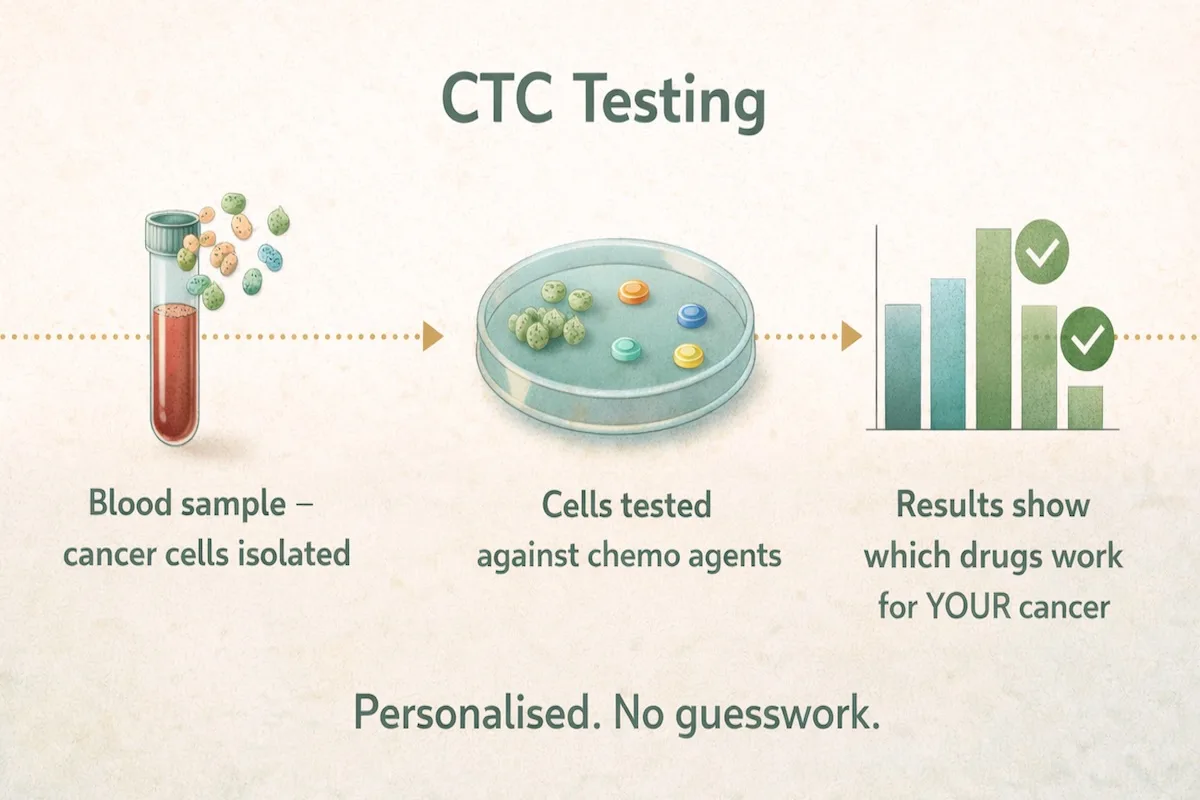
How CTC chemo sensitivity testing works — blood test to personalised treatment
On This Page

Quick Facts

Test Type
Simple blood draw
Results
Approx. 2 weeks
Use
Personalise chemo choice
Arranged Via
Cancer SA, Centurion

What Is the Problem With Standard Chemo Selection?

When your oncologist recommends chemotherapy, the drugs are usually chosen based on what works best for most patients with your type of cancer — based on large clinical trials and treatment guidelines.

But you are not "most patients." Your cancer is unique to you. Two people with the exact same diagnosis can respond completely differently to the same drugs. One may respond well. The other may endure all the side effects with little benefit.

Currently, there is no standard method in conventional oncology to predict in advance which drugs will work best for your specific cancer. Unless you test it first.

This approach is part of integrative medicine, where treatments are selected based on individual patient needs and may be used alongside or in consideration of conventional medical care.

"Imagine being able to test your cancer cells against different chemotherapy drugs in a laboratory — and knowing which ones work before you put them into your body."

How Chemo Sensitivity Testing Works

1

Simple Blood Draw

A standard blood sample is taken at our Centurion clinic. That is all we need from you.

2

Lab Isolates Your Cancer Cells

A specialist laboratory isolates the live cancer cells circulating in your blood, cultures them, and exposes them to a panel of chemotherapy drugs.

3

Your Personalised Report

You receive a ranked report showing which drugs are most effective against your specific cancer cells — and which ones are ineffective.

Results are typically available within 2–3 weeks.

Same Cancer, Different Response

Personalised cancer treatment

This is why chemo sensitivity testing matters:

Patient A — Stage 3 Breast Cancer

Chemo sensitivity test shows her cancer cells respond strongly to Carboplatin and Paclitaxel. These drugs are selected for her IPTLD protocol.

Result: Treatment targets the cancer effectively.

Patient B — Stage 3 Breast Cancer

Same diagnosis, but her test shows those drugs have minimal effect. Her cancer responds to Doxorubicin and Cyclophosphamide instead.

Without the test, she may have received drugs that would not have worked.

This is the power of personalised treatment. We use the drugs your cancer responds to — not the drugs that work for "most people."

Your Scans Are Clear — But Are You Really Cancer-Free?

Scans can only detect tumours once they reach a certain size — typically 5 to 10 millimetres. By that point, the tumour already contains millions of cancer cells.

This is the test you want if you need peace of mind.

Know for certain whether cancer cells are still active in your body — do not rely on scans alone.

Why This Matters Even More With IPTLD

At Cancer SA, we use IPTLD — low-dose chemotherapy that targets cancer cells through insulin potentiation. Because we use a fraction of the standard dose, it is even more important that we use the right drugs.

  • Know which drugs work before you start treatment
  • Avoid wasted treatment cycles with ineffective drugs
  • Avoid side effects from drugs that would not help
  • Monitor remission with a test more sensitive than scans

How to Arrange Chemo Sensitivity Testing

1
Book a consultation — bring your latest oncology reports, pathology results, and scan results.
2
Blood sample — drawn at our clinic and shipped to the specialist laboratory under controlled conditions.
3
Results in 2–3 weeks — your cancer cells are tested against a full panel of chemotherapy drugs and natural substances.
4
Personalised protocol — Dr Pretorius designs your IPTLD treatment using the agents shown in laboratory testing to target your cancer.

Patients from Pretoria, Johannesburg, across Gauteng, and even neighbouring countries arrange CTC testing through our Centurion practice. If you cannot visit for the blood draw, alternative arrangements can be discussed.

What to Expect

Treatment begins with an initial consultation where your medical history is reviewed in detail. A personalised plan is then developed based on your specific condition and goals.

Ongoing monitoring is carried out to assess response and adjust the approach as needed. Each patient's experience may differ depending on their overall health and treatment plan.

Frequently Asked Questions

Chemo sensitivity testing (also called chemosensitivity assay or CTC drug testing) takes your living cancer cells and exposes them to different chemotherapy drugs in the laboratory. The lab measures which drugs are most effective against your cancer cells and which ones have little or no effect. The result is a personalised report that shows Dr Pretorius exactly which agents to use in your treatment.
A simple blood draw is all that is needed. Your blood is sent to a specialised laboratory that isolates the circulating tumour cells (CTCs) — live cancer cells that have entered your bloodstream from the tumour. These living cells are then cultured and tested against a panel of chemotherapy drugs and natural substances.
Yes. CTC testing can detect cancer cells circulating in your bloodstream potentially earlier than changes would appear on standard imaging. If your scans are clear but CTCs are still detected, it means cancer cells are still active in your body. This early warning gives you and Dr Pretorius time to act before the cancer re-establishes itself.
Most conventional oncologists select chemotherapy drugs based on large clinical trials — what works best for most patients with your cancer type. Chemo sensitivity testing takes a personalised approach, testing what works for your specific cancer. The technology is available through specialised laboratories, and integrative practitioners like Dr Pretorius use the results to tailor treatment protocols.
Chemo sensitivity testing is a specialised laboratory test and is generally not covered by South African medical aids. We provide a full cost breakdown during your consultation. Many patients consider it a worthwhile investment — knowing in advance which drugs will work for you avoids wasted treatment cycles and unnecessary side effects from ineffective drugs.
Anyone about to start chemotherapy, anyone whose current chemo is not working well, and anyone in remission who wants to know for certain whether cancer cells are still present. It is particularly valuable if you want to use IPTLD low-dose chemotherapy — we can select the exact agents that your cancer responds to, making the low-dose approach even more targeted and effective.

Important Information

All treatments are provided within an integrative care framework and are tailored to the individual. They are not intended to replace necessary conventional medical care where required. Patients are encouraged to discuss all treatment options with their healthcare providers.

Individual results vary. The information on this website is for educational purposes and does not constitute medical advice.

You May Also Be Interested In

Find Out Which Treatment Will Work for Your Cancer

Our team will review your information and guide you on possible next steps based on your situation.

Call Now WhatsApp

Questions about treatment?

WhatsApp Dr Pretorius directly — he personally responds to every message as soon as he can, during clinic hours only (Mon–Fri, 08:00–14:00).

Start WhatsApp chat